Showing posts with label archi. Show all posts

Monday, 14 May 2007

Exterior of white mosques in the centre of Alex

The most remarkable place in the old city centre of Alexandria is a group of beautiful mosques in the Anfushi area. This neighborhood is a nowadays a very poor area, but still conserves some of the taste of its great past. In this alleyway i found food stalls, parked carretas and children playing football with a can, the Sidi Yakout El-Arsh mosque stands bright white in the background:


In this picture, the contrast is of other nature. I heard once that the aspirations and power of a civilization can be analyzed by finding the tallest buildings in a city...nowadays are not cathedrals, lighthouses or minarets anymore...


The domes in the
Yakout mosque are extremely pretty with their intricate geometrical patterns, the openings that accentuate the verticallity and the typical little spheres topping them:

In here the mosque from the side and the classic stall selling tea and coffee:


In the same square the Sharaf al-Din al-Busiri Mosque and mausoleum can be found. It is a tiny but charming little mosque, were one of the great sufi characters is buried. The long complete name of this man was: Sharafud´-dini Muhammad bin Sa´idi bin Hammadi bin Muhsini bin Sanhaji as-Sanhaji al-Busiri...Al-Busiri A.D.) was an Egyptian of Berber Maghrebi (Moroccan) ascendants from a poor family, who excelled as calligrapher, traditionalist and sufi poet. An interesting fact is that he memorised the whole Holy Qur2an at the age of 13 (!!!). This was the first mosque in Alexandria that i entered; the tomb is said to have el-Barakah (blessing) and that motivates mothers with their little children to visit the highly decorated burial place. Architecturally, the most remarkable elements of this building are the lovely interior marble patio and the silver domes:


The mosque of Abu Abbas al-Mursi occupies the central place in the square. This mosque constructed in 1775 by Algerians, built over the tomb of the Andalusian saint and mystic, Sheikh Shehab El Din Abu El Abbas Ahmed Ibn Umar Ibn Mohamed Al Ansary El Mursi, who joined and then lead the Shadhali Tariqa (Tariqa is a brotherhood, or of school of thought). Al-Mursi ( A.D.) was born in Murcia (as his name indicates) and lived in Seville with his wealthy family working in the trading business. With 23 years he moved to Tunisia where he met El Sheikh Abu El Hassan El Shazly and accompanied him to Alexandria. Here, he stayed as a Muslim teacher for 43 years until his death and was widely regarded for his commitment to help the less favoured in society. The building itself has a very long history, beginning just with the tomb, it was successively enlarged and repaired throughout the centuries until the completion of the final building in the aforementioned date by Sheikh Abu el Hassan El Maghreby. The last reconstruction was done in 1943 by King Farouk, when the mosque was decorated in the Ayyubid style, the popular style at the time of the emigration of Al-Mursi. The shining has been (and still is) visited by many pilgrims from North Africa in their way to Mecca for centuries.

In here the side view of the Al-Mursi mosque from the underground commercial area in the centre of the square:


A close up from the back entrance:


In here the front entrance, where it can be read: "Do not forget Allah", and locals sell some of the typical
made in china stuff:


A detail of the pattern of one of the windows:


In here the balcona with Mashrabiya on the side:


And how not? a cat guards the entrance to the toilet of the Mosque :)

Tuesday, 24 April 2007

King Farouk´s palace and gardens

Here we have a green area, the one closest to Miami in Montazar, south Alex. Apart of being one of the few green areas, is not free to enter and is open to public only when security reasons do not oblige to close it. This beautiful lion welcomes you the the garden:


These gardens host the palace of King Farouk, the controversial penultimate king of Egypt, built in the mid XX century. Today is the Presidential Residence and the interior of the palace cannot be accessed by the public, so unfortunately the otherwise beautiful visit was reduced to a walk in the gardens. The Italian architect (i cannot be bothered to find out his name, im not interested) mixed a variety of styles: a tower in the corner resembling a minaret...but not quite:

And we always need more details, these stairs looks like extracted from an Gothic abbey:

And this reminded me of the words of Charles Correa when talking about Indian gardens: "when the built elements catch part of the sky"

The place when looked closely gives the sensation of a luxurious fortification. And those overhanging roofs...arent they the same than in my parents place in Santa Clara (Sevilla)?


The pines, palm trees and grass surround the palace. This particular view reminded me of south of Morocco (Agdz for example :P)


And in the middle of the palm trees this recently built white void tower is found, being a water deposit:


Some nice details were scattered around, the lamp posts:

The sleeping Lions on a fountain, but the tale tell us that the sleeping looking Lion is really awake, and the Lion with open eyes is really sleeping...


One of the palm tree wood bridges, with the pine trees in the background:


One detail of the sitting place in one of the kiosks built with wood and palm leaves:


The coast surrounds half of the perimeter, the ever present Mediterraneo in Alex. Lovely that was early in the morning and it is still not summer, so the place was deserted:


King Farouk even built an island in for drinking tea at 5pm, some say that he built the whole complex for that reason :D does it really matter? The rich people keep enjoying their tea in here, but in these days in their luxurious yatchs, the lighthouse help them to find their way:


And this fisherman was here at early time to catch his lunch:

And in here a couple more of fishermen in a concrete structure that is literally falling down. I think that is obvious the life time of this building material, no wonder why companies do not insure concrete buildings for longer than 10 or 25 years...meanwhile the pyramids in Giza and the Yemen stone and mud skyscrapers are still there after thousands of years:


Observe how in the first line of coast within the complex they are building these little beach houses, and they are selling them at ridiculous prices...and those beaches are private of course, so they are not accessible to the public either. They have built more things within the massive extension, like the Palestine Hotel (ugly and out of context) and a disco... Weird flavoured place...not quite my favourite taste.

Friday, 6 April 2007

The new Opera house in Cairo and the Nipon connection

One of my favourite places in Cairo is the new Opera House of the Egyptian National Cultural Center. It is a complex inaugurated in 1988, seventeen years after the Royal Opera House was completely destroyed by fire. The complex is a series of nicely designed and constructed buildings comprising halls, amphitheaters, theaters, galleries and the music library. It is a reduct of peace in the middle of the jungle where to relax, have a coffee and attend some of the many events (we found by chance a Nubian concert):

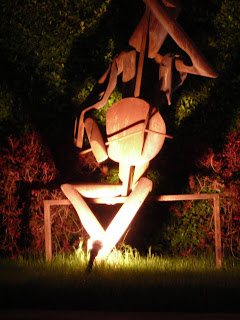
Beautiful metal sculptures are scattered around; the violinist:

The stone totem:

The metal worker:

And my favourite, the human brain being driven by an angel and a devil that have gone to the head from the lower part of the body walking upstairs :

And here is me sitting with the sculpture of the great Mohammed Al Wahhab:


This whole complex was built in cooperation with the JICA, the Japan International Co-operation Agency. I did not know that the friendship between Japan and Masr was so deeply rooted...i found this Japanese garden close to the orphanage with a lake surrounded by fifty something massive pink sculptures of Buda...

...with a classic high rise building in the background. In the middle of Helwan, being so far away from the city center, is odd that there is this garden where a pagoda with the minaret of the mosque in the background makes an unexpected sign of communion between such two distant cultures:


Furthermore, just opposite to this last photo (around 171º rotation angle for the picky ones) this classic looking building is found:


what to say? wiriwiked! wiked! Helwan is massive...around 2 million people to be exact ;)


zayy el amar awi...

Monday, 2 April 2007

Chaos and the high places in Cairo

I have been the last days in Cairo, the first proper contact i had with this city. I have to say that i do not enjoy massive cities, i feel lost and stressed. Cairo fulfilled all my fears...the mad drivers in Alexandria are the chauffeur of "driving miss daisy" when compared with those in Cairo. Your life is continuously under threat when crossing a street or walking along, as many of the pavements are little urban jokes. Actually in Cairo there are many traffic lights (not like in Alex), the only problem is that they do not work in the classic green, yellow, red international code...nobody could tell me what this meant:


The first day, after just 3 hours walking around the city, the continuous noise of horns, the shouts, the tides of people and the pollution got me totally exhausted. I thought i was not going to survive in here for very long, but actually the next day my brain learned how to ignore all those external influences and i begun to really enjoy it here. The city of Cairo is really impressive, old and filled with flavour, and no wonder why it was named as the city of the thousand minarets. The first important turistic visit was to the citadel, a fortification on top of a hill that has been since the XIII century to the XIX century owned by Ayyubid, Mamluk, Ottoman, and Khedival rulers. The massive Mohammad Ali Mosque (Ottoman):


As it can be seen, the exterior of this Mosque is absolutely impressive...as impressive are the views from this hill, in here the Sultan Hassan Mosque and Madrassa protruding from the city:


The patio of ablutions is simply maaaarblelous:


The minaret from the patio:

The domes from the interior:


It is a real shame that (in such a grandiose building) it feels more like a touristic attraction than a worship place; european and american women walk around with green cloaks for covering their indecent clothes (for a Mosque it is, almost nobody would think to go to the opera with shorts and flip flops).

Another mosque within the walls of the citadel is the Sultan al-Nasir Muhammad ibn Qala´un Mosque, built two centuries after the great Mosque of Isbiliah, resulted more charming for me. The exterior view is dominated by a green ceramic dome that corresponds to a late addition:


The texture is roughly elegant in the interior, columns from different origin surround squared plan with no walls enclosing any space:


The simple decoration consisting in hanging lamps draws you closer to the austere origins of Islam:


The Al-Azhar Park is the best green space in the city, this 30 hectare complex of gardens and buildings constructed by the Aga Khan Trust in 1984 is in a hill not that far from that of the citadel. The views of the city from the observatory, the walk around the lake, the channels of water that travel along the paths, the beautiful building of the restaurant conform a delicious island of peace in this chaotic city. Within the park there is an amphitheater for performances, i attended two concerts during the week, one of three Egyptian groups and another of Oriental flamenco...i absolutely loved it :)

I love high places with beautiful views, together with the citadel and the park i had to visit Mohatam, the highest place in Cairo where u can see the real extent of this sixteen million people urb, the 7th more populated metropolitan area in the world and the largest in Africa. The character of this place is quite odd at night: lovers, young people partying, old men with women of light horse shoes (ligeras de cascos), egnabis (guiris or gauris) in touristic buses gather together in front of the impressive views. In there i allowed myself to take some arty pics using the lights of the city :P


Apart of such high places there are another billion places to visit down in the city: the Mosque of Ibn Tulun, Hussein Mosque, el zouk el kalili, Al Azhar University, etc... (this etcetera is quite large, for example in 12 km of a El-oaz street there are 6732 monuments, the estimation is that u would need 8 months full time for visiting all the monuments in Cairo). I promise will come back to it...

Thursday, 15 March 2007

The architectural rant

Not so long ago Alexandria was a city of low rise buildings, with front gardens where children used to play safely under the view of their families. Around 30 years ago such model begun to crumble to leave space for a so called "progress"; the owners of the houses were (and still are) seduced by the idea of selling out making massive profits...(dinero es el unico dios verdadero?). Nowadays there are few of the original buildings left, like tiny creatures surrounded by a world where they will not be able to survive. They were condemned to certain extinction long time ago... this one in my street reads the proud statement: "this building is not for sale, for more information call lawyer fulan"...i wonder for how long.

Note that the colour of the building in the photograph has been enhanced because i felt like it :P I have already showed some high buildings rising from relatively small bases thanks to the black magic of concrete, every square centimeter meter is treated like a potential 13 floors high building. This is the block where our flat is, note that the big space in the back of it is a new construction site.

Due to this particular way of understanding (??!) urban planning and development, the density of population in Alexandria is tremendously high. Such high density posses a further problem in a developing country like Masr, as the deficient public transport system is unable to cope with all these people, collapsing the streets with more cars, with the consequent degradation of the air quality. Furthermore, as buildings are separated of each other by a couple of meters, ventilation and natural lighting are poor. If that was not enough, the small gaps between buildings are not the paradigm of cleanliness, as people simply chuck stuff in there. An illustrating example is the beauty of the "view" from our living room:

Other consequences on the quality of life is that the reception of radio signals and mobile phones inside those buildings is very limited. So we are forced to hang outside the window for having a proper conversation...And by the way, green areas are not to be found anywhere, except inside private residences of relatively wealthy people. I wonder what is the responsibility of governments and designers (together with clients). Dont they realise that besides the great wonderful money they are making, they are leaving a legacy of houses and neighborhoods where it is not very desirable to live in? Surely that does not matter as none of them live in a place like miami, they can live in some nicer place...unlike most of urban population in the world.

Thursday, 8 March 2007

The architectural and egyptian paperwork week

The first architect in the week was M.Rifaie on Monday, who drove me to the Arab Academy of Sciences (AAS) and facilitated me access to the architecture department library (RIBA accredited degree). In there (limited but high quality collection) i studied books on Hassan Fathy keeping up with my research on Egyptian vernacular and in the hope of meeting some people that could lead me to architects that are maintaining their traditional methods. My hopes proved correct! I met various architects that facilitated me some names and places where to keep digging. Ahmed is working in a practice in Cairo and when he found out about my research asked me very kindly if he could accompany me in my walks in his city. He has studied the work of the great Fathy but, as sevillians rarely go up to the Giralda, he has not personally visited them; so i will have some expert company. He was especially helpful in giving me some background information about the history of the capital and the remainings of buildings of the past. His help was not only restricted to that, he forwarded me information about the incredible lecture that i assisted last night in Biblioteka Alexandrina (i will detail later). The second contact was the architect Mr.Yunus who led me to the work of PhD A.B.Elseragy (thesis title: Architectural and solar potential of curved and flat roofs in hot arid regions) by the University of Nottingham and currently working in the AAS; fortunately they had a copy of his thesis in the library and i had the chance to have a look to it (ill have to return to this one). Mr.Yunus is helping me too to arrange a meeting with PhD. G.Moshad, as she researched egyptian vernacular in her doctorate. I really thank Mr.Yunus for his help; research would be an impossible task without the help of the local experts. Mr. Rifaie, a very busy and talented young man, not only made all of this possible by investing his precious time in me, but we found a very interesting project where we might collaborate in the future .

On Tuesday i received more help, this time from Aya, an architect from Alexandria University. She offered some of her holiday time to help me to gain access to the library of her University to assist me in my research. First we went to the University with my certificates and identification, we sat in the security office for half an hour before the security man could work out what was the procedure. The procedure was that I needed an approved paper from a different office...that is exactly the kind of thing i was trying to avoid. So we walked 15 minutes to the next stop, spoke with some people and found the woman that deals with this sort of cases for international people. Very kind woman indeed, what i do not understand is how a person in her specific position does not speaks English or French!!! but at least we seemed to be going somewhere, i needed a couple of photocopies of my passport, my spanish ID, my letter from Bath University and the corresponding translation to Arabic...and even prove of my application to Cambridge University, thank god that i was not asked for my birth certificate. I did not have all of these on me, and of course that was impossible to return with them on the same day (cos they close at 2pm), so we arranged to come back the following day. I did not think that Aya had to come with me next day, but the woman in the office insisted quite forcefully that she should. So Aya, again, had to spend more of her time in that office, apart of making me the favour of translating my letter from Bath University. We arranged to meet next day in Biblioteka Alexandrina to go together, but the lack of morning coffee mixed with my lack of sleep made me go in the morning to the office instead and i forgot totally about the real meeting place. If that was not enough and as most of you know already, many times my mobile is a purely decorative object i carry around with no battery with the sole purpose of occupying space in my bag. So basically i left her waiting for me for 45 minutes with my mobile off until i could work out a way to contact her (her number locked inside the idiotic item). I felt so embarrassed that, on top of all the time and help, i made her wait. In the mean time, i hanged around with all the security people in there, i got introduced to everyone of them, they brought me tea, offered me cigarettes and ask me about Real Madrid and Barcelona FC and told me about the local football teams (here you are Jimmo, the comment you were waiting for). So finally Aya arrived much less pissed off that what i was expecting and i lost the count of the times i said "sorry". So, back to the international woman that does not speak any other language but Arabic, we handed all the papers and everything seemed (and i mean it, just seemed) fine after some complimentary 30 minutes of discussion, apart of the fact that we found out that this permission document was valid just for 4 entrances to the library...ok then! But there was a little final requirement: i needed the signature on the document of the head of security to validate everything, they might think that a Christian terrorist might blow up their library...fair enough! I thought that was going to be a piece of cake as i knew already all the security people...but no!!! after another 30 minutes waiting i was informed that the man could not sign the frigging paper that day and that i should come back the following day for it!...agggghhh!! i was beginning to lose my patience, that place looked pretty much like the mad house of the 12 works of Asterix and Obelix..but ok...just one more day and i could go to the library, i just want to read!

After the early morning hassle, i went to meet Dani (Spanish psychologist) in his workplace, the Alex Med Centre (https://www.bibalex.org/English/researchers/Alexmed/alexmedcenter.htm). It is a very reputed research centre within Biblioteca Alexandrina. There are many architects working there, some of whom i got introduced to. I spent half of my time theoritising to work out with Mr.Karakiri the possible use of one anomalous tower in the archaeological site he is studying. My suggestion was a particular astronomical use, but we require the exact calculation of the orientation of the complex to know if i was right in my guess. The other half of the time, i spent it Dr.Aref, who helped me greatly to find out more names that i should dig in, and some potential problematics that i might find out when implementing my proposition. Very critical, very insightful, very kind...very useful. I met the subdirector of the centre, but i failed (just then) to meet one of the people i have been wanting to meet even before arriving, Prof. Mohamed Aued, the director of the centre and one of the most prominent egyptian architects of our times. But due to that, he is an incredibly busy man...i had to wait

So today i had come back to the mad building again, one of the security people led me to another and this one to another one. They did not seem very busy at all, in groups of sixes or sevens sitting in many offices smoking cigarettes and drinking litres of tea. In the fourth room i saw the first of them actually "working", he was typing in an old looking computer with his two index fingers at a rate of approximately one stroke per second, with breaks to smoke and sip his drink (no much stress, i see). So after asking and asking about my paper, they could just ask me where were my papers...oh no! they did not have a clue of what i was talking about. Finally one of them seemed to understand...or did he? he told me to sit, order one of the others to bring me more tea and he begun to call in the phone. Meanwhile, seven officers stood in the office and talking in arabic about me...i could catch doctor, isbany, isbilliah and things of the sort. After the third call of the guy, interrupted by a 5 minute call to his wife, he told me everything was ok...yeah? where is my paper then?. He answered me that there is no paper!!! that i just have to go to the library and ask for fulan and give him his name and mine and he will know what i am talking about...so conclusion: i went out of all of that hassle with a couple of arabic names that i scribbled in a post-it!!!...i really cant wait to go to the library and find out the rest of this story and wasting some more of my time drinking tea and watching more officers talk in the phone, i cant get enough of it. This is one of the few moments when i come to realise how much i miss England.

The architectural week culminated today in big style. I assisted the lecture, organized by Prof. Aued, and named "the language of architecture" by Charles Correa, (http://www.charlescorrea.net/) world famous Indian architect, planner, activist and theoretician, winner of the Agha Khan Award in 1998. He is one of few great architects originally from the developing world that has built most of his works in his country of origin, and still gained wide recognition from western countries from it. He studied in Michigan University and MIT and then came back to India, where he made tremendous effort to adapt the technical advances of the modernist architecture to vernacular typologies. That makes him tremendously relevant for my research, as he has managed to draw a successful bridge between the past and the future. He has been specially concerned with using modern building technologies for designing low cost shelter in developing countries respecting the cultural values of the place. His presentation was simply wonderful, he explained many of his works and how he developed his own language of architecture, some extracts from it:

-"developing a language of design respecting the local cultural values"
-"This power point thing is a menace" (when the presentation was giving him some technical problems)
-"understanding the past to understand the aspirations of the people in the present"
-"an architect should only build in places where he has been living in" (criticising architects that build in places that they have no previous cultural knowledge of)
-"Simply copying an existing building or typology is kitsch; the transformation of old cultural and architectural concepts for fulfilling the needs of the users is good practice"
-"Incrementality, Pluralism, Participation, Income generation, Equity, Open to sky space and maleability"
-"build a rich building that poor people can enjoy without being intimidated by it" (in reference to the Ghandi Museum designed by him)
-"The centrality of an empty space in hot arid climates is related to the ancient idea that enlightenment can just be achieved in open air"
-"achieving complexity through manipulation of simple structures"
-"the beauty of science is undervalued nowadays"

The humanity that this venerable man transpired, his words encouraging the young audience of architecture students to innovate, his humility and simplicity made me love the man even more than the architect. He has become in 3 hours in one of my heroes (thanks Ahmed for telling me about this lecture, i will be gratefull for the rest of my life). And that was not all, among others, i met Mr.Gharib a PhD student in the AAS that is researching in Life Cycle Assessment of buildings and another teacher in Alex University who is going to help me circumvent all the stupid paperwork. And finally, i managed to meet, with some bravery of my part, Prof. Aued!!! i asked to meet at some point with him and he kindly passed his arm over my shoulders and accepted with a smile in his face. I hope he does not forget me!

The greatest sunset i have seen in my life, yesterday form the ship building site in Alexandria. As my strict principles dictate, the colours are not photoshoped...but i could have done it to clean to beach :P


Curiosity of the day: Hassan Fathy found a perfect moment for the implementation of his ideas about recovering vernacular architecture when Egypt suffered shortage of modern building materials due to the sanctions imposed after the declaration of independence of Egypt from England in 1956.

Tuesday, 20 February 2007

Walk in the centre of Alex and the little translation game

Yesterday i went with Belal to the city centre of Alexandria for a meeting in Caritas Egypt and for taking some pictures. I found the centre a very familiar scenario, the views in there are not so different from those ones found in Seville: orange trees, narrow streets and balconies in every building. A typical example of a balcona (yes, another common word in spanish and arabic) can be seen in the picture:


Obviously, the style of many of the buildings are not so similar to those found in Al-Andalus, but dont you find some of the arches in this building reminiscent to those found in the Great Mosque of Cordoba, and others sort of quotating Gothic style?


I know that some of you will be wondering: what are normal looking buildings doing in this blog?, sincerely i just did not want to give the wrong impression of Alexandria city centre. In spite of the most of buildings in there being shocking just for their disrepair state, i manage to find the following pearl among them:

What else can be said? An image worth a million words! A funny thing that happened while taking this picture, is that a couple of girls that pass through there every day noticed for the fist time the building when they saw me photographing it. Their comment (thanks to Belal for the translation) was something like: "Oh, i never notice how beautiful this was!"...emmm obviously they did not have a clue of what my opinion was.

Another similarity i found between Sevilla and Alex is the ridiculous number of coche de caballos in the streets to show the city to (and to extortionate) visiting foreigners:

The driver´s face made me laugh for the calm that transpired out of him, simply lovely! Just round the corner from where this driver was smoking and chilling, i found this the door of a cafe; i just could not get my eyes out of it:


So here is the little translation game: can anybody guess what is this all about? The person that guess right will get a golden cockphant (or gallifante for spanish speakers). The solution to this puzzle will be revealed in the next few days...enjoy!

PS: Party cannot participate in the game cos he already almost died laughing when i told him the solution